B.S. in Statistics and Mathematics · 2023
University of Wisconsin–Madison


My work connects statistical modeling, software engineering, and manufacturing operations data. I hold a B.S. in Statistics and Mathematics and an M.S. in Statistics from the University of Wisconsin–Madison, and I am currently pursuing an M.S. in Computer Science at the University of Southern California.
My experience spans data analysis, predictive modeling, full-stack development, and mobile applications, extending to manufacturing challenges in cost, inventory, and supply. I aim to combine reliable analytical methods with software that makes results understandable, verifiable, and useful.

My academic path began in computer science, developed through statistics and mathematics, and returned to software and systems development. Statistical training taught me to examine evidence, models, and uncertainty; computer science helps me turn analytical methods into working applications.
In industry, I have contributed to data preparation, predictive modeling, and inventory visualization. I also exchange technical ideas through forum presentations and project reviews. These experiences have broadened my focus from model outputs to usability, business context, and implementation outcomes.
University of Wisconsin–Madison
University of Wisconsin–Madison
University of Southern California
Identify the business objective, constraints, and success criteria.
Align data entities, time periods, and status definitions.
Select robust, interpretable methods that can be validated.
Present options, evidence, expected effects, and uncertainty.
Integrate responsibilities, approvals, and exception handling.
Review actual outcomes and refine models and rules.
Identifies key cost drivers to support trend forecasting, variance explanation, and optimization analysis.
Registration No.: 2025SR1594104Connects goods movements, transport status, and expense records to identify cost changes and reconciliation discrepancies.
Registration No.: 2025SR1605165Uses time-series analysis to examine inventory composition, replenishment needs, and capital tied up in stock.
Registration No.: 2025SR1605187Detects unusual changes in supply, inventory, and production data and generates risk alerts.
Registration No.: 2025SR1594094Quantifies the operational effects of purchasing timing, inventory conditions, and procurement strategies.
Registration No.: 2025SR1605201Integrates data from multiple business sources to explain drivers, compare scenarios, and review performance.
Registration No.: 2025SR1605166
Cost forecasting, inventory composition, and working capital.
Inventory monitoring, goods tracking, and expense alerts.
Purchasing timing, inventory turnover, and return simulations.
Coordinated monitoring of costs, inventory, and supply anomalies.
Adaptation to business processes and data maturity.

Individual professional recognition
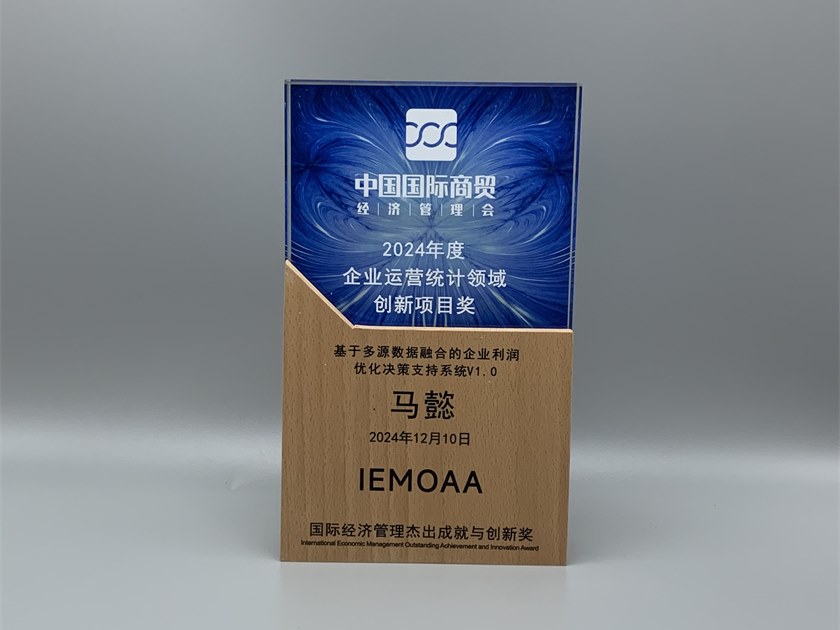
Enterprise Profit Optimization Decision Support System V1.0
Focused on operational data in U.S. small and medium-sized manufacturers, the paper examines data preparation, model validation, phased pilots, and ongoing evaluation, linking statistical analysis to business decisions.
Original Chinese PDF · 38 pages