Chapter 13 · Page 26
Process Standardization and Data Preparation
Defines the minimum dataset for a specific decision, aligning events, fields, and quality rules while assigning maintenance responsibilities and exception procedures.

U.S. Small and Medium-Sized Manufacturers · White Paper
This white paper examines how U.S. small and medium-sized manufacturers can use existing operational data to apply statistical analysis and software systems to business decisions, providing a framework from data preparation and model validation to phased implementation.
Original Chinese PDF · 38 pages

The 20 chapters address the practical constraints of U.S. small and medium-sized manufacturers, progressing from assessment and framework design to implementation validation and outcome evaluation.
Defines the research scope, examines operating characteristics, transformation drivers, and external constraints, and establishes an operational data intelligence maturity model.
Examines gaps in process accountability, delayed cost information and decisions, multi-source data coordination, inventory and supply risks, model credibility, and organizational adoption.
Connects data, decisions, and feedback through four areas: data preparation, business analytics, inventory and supply risk, and cost and purchasing decision support.
Addresses model validation, human–machine collaboration, phased pilots, outcome evaluation, and risk mitigation, with conditions for broader adoption and future development.
Chapter 12 · The Overall Feedback Framework
Aligns entities, timestamps, fields, and quality requirements across materials, orders, inventory, and expenses.
A minimum viable datasetUses forecasting, anomaly detection, and scenario comparison to produce interpretable results with defined applicability.
Analysis and validation recordsTurns results into options and priorities, with clear approval authority, implementation responsibility, and decision windows.
Decision packages and execution recordsCompares baselines with actual results, tracking adoption, coverage, and exceptions to determine whether to continue or adjust.
Evidence for review and adjustmentThroughout the ProcessTraceable dataClear authority and accountabilityReviewable versionsReversible workflows
From data preparation to model validation, the framework defines prerequisites and an implementation path. The page images below reproduce the Chinese original.
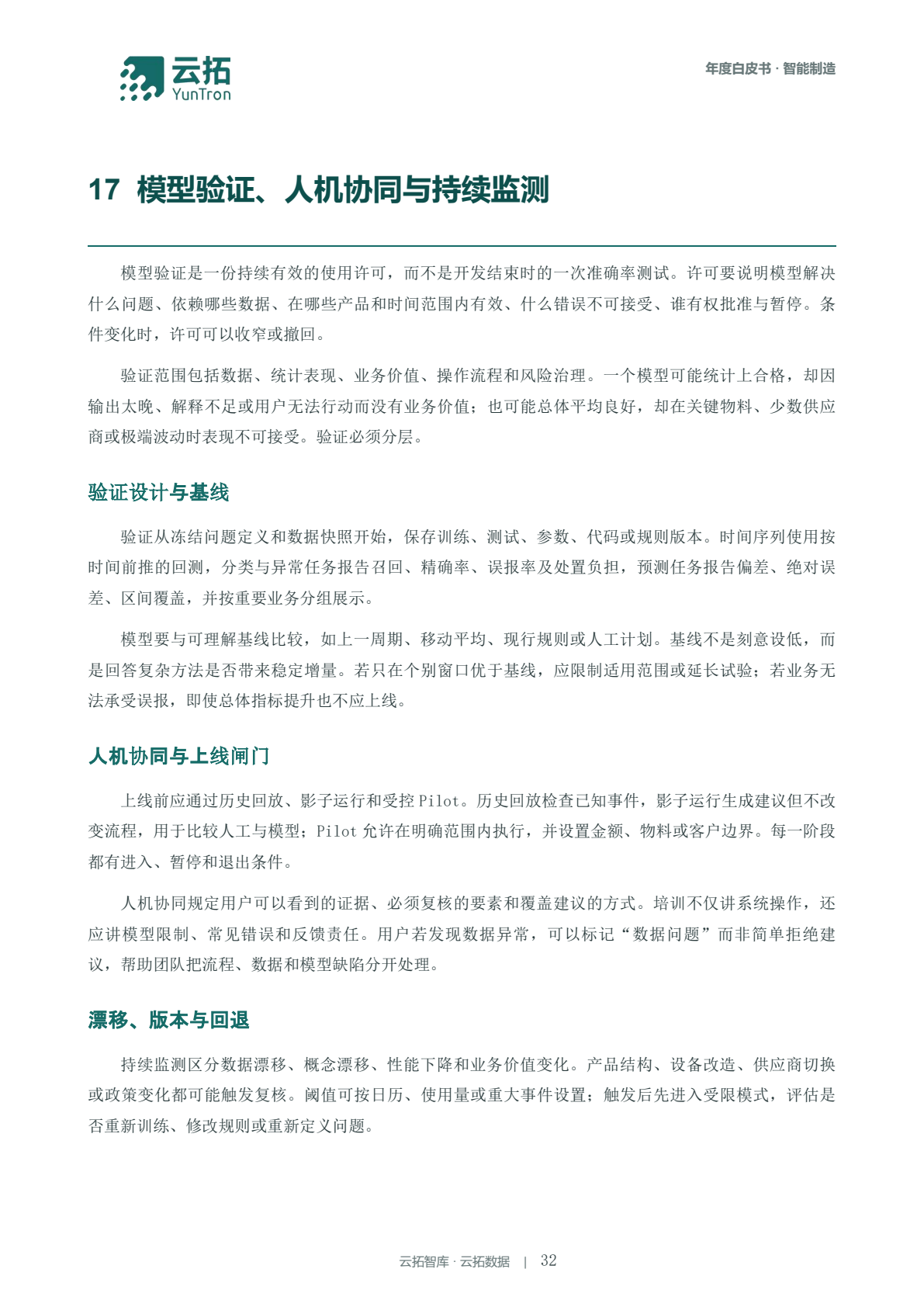
Chapter 13 · Page 26
Defines the minimum dataset for a specific decision, aligning events, fields, and quality rules while assigning maintenance responsibilities and exception procedures.
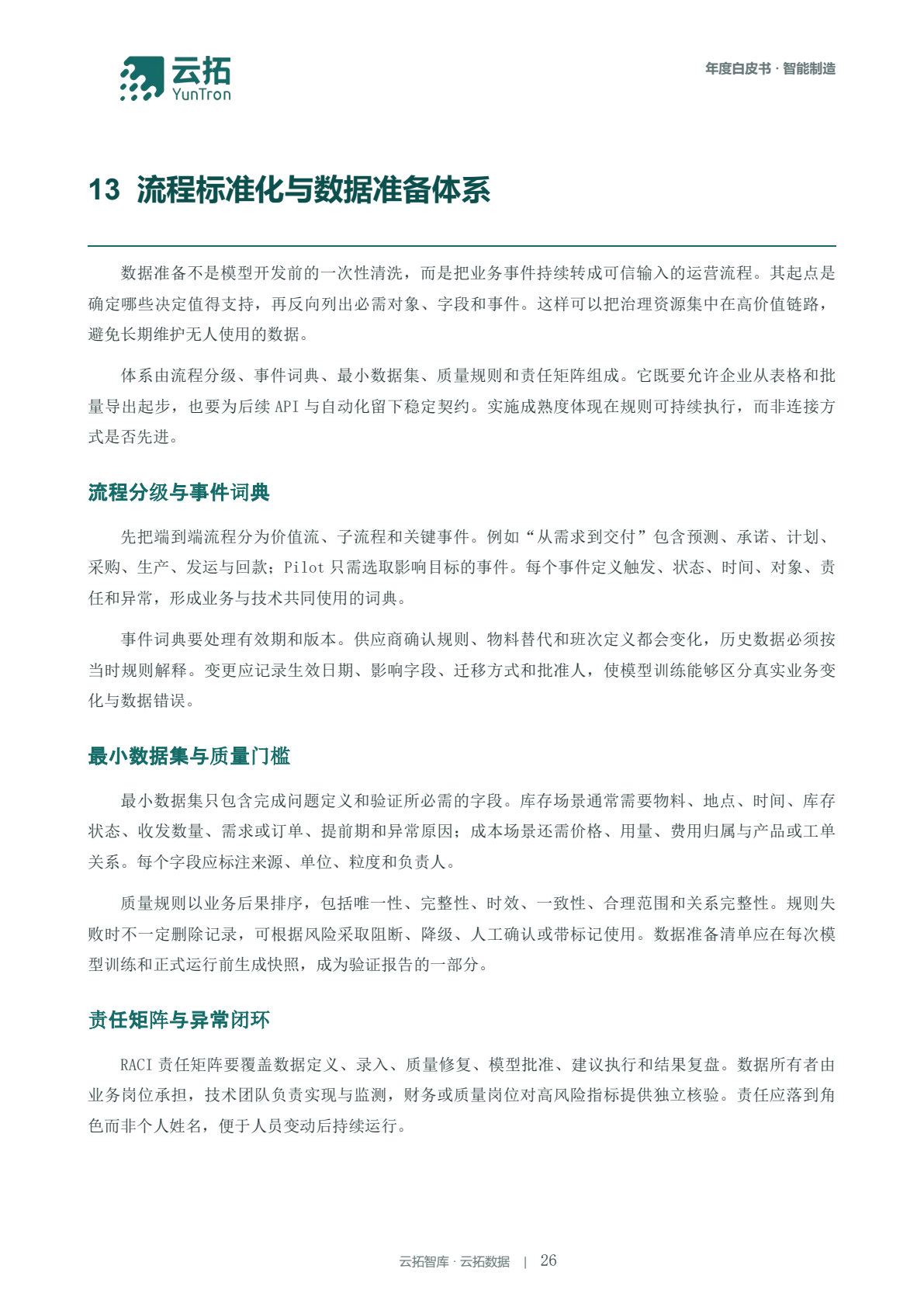
Chapter 17 · Page 32
Compares models with existing approaches through historical replay, shadow operation, and controlled pilots, retaining human review and rollback mechanisms.